
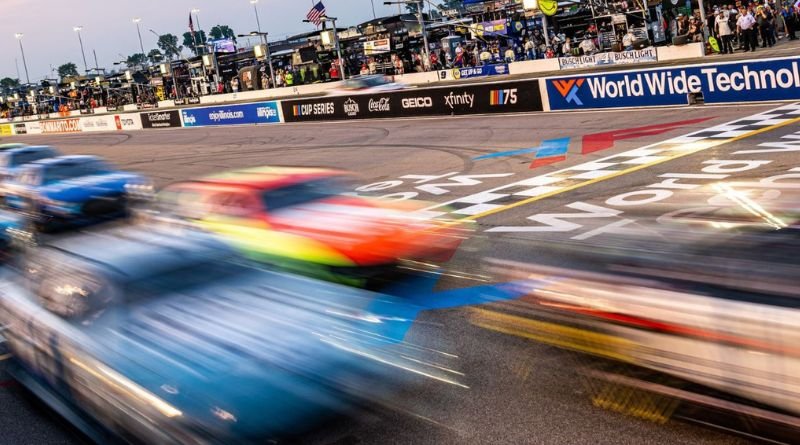
If you’re heading to World Wide Technology Raceway for the first time — whether for NASCAR, IndyCar, or NHRA drag racing — you probably have the same questions everyone does: what’s the track actually like, which events are worth planning a trip around, and what should you know before you show up.
This guide covers the track’s layout and history, the 2026 event schedule, what to expect on race day, and practical tips for getting there and getting the most out of your visit, whether it’s your first race or your fifteenth.
Where Is World Wide Technology Raceway?
World Wide Technology Raceway — often shortened to WWT Raceway or WWTR — sits in Madison, Illinois, just across the Mississippi River from St. Louis, Missouri, in the Metro East region. Despite the Illinois address, most visitors approach it as a St. Louis-area venue, since it’s only a short drive from downtown St. Louis and easily reached from either side of the river.
The facility covers more than 600 acres and functions as one of the largest outdoor entertainment venues in the entire St. Louis region — not just a single track, but a full motorsports complex combining an oval, two road courses, a drag strip, and a karting facility on one property.
The Track: Why Drivers and Fans Both Like It
The main oval is 1.25 miles long and shaped somewhat like an egg — a design that creates genuinely different racing characteristics in each half of the track, which is part of why drivers consistently name it as one of their favorite ovals on the calendar.
Turns 1 and 2 are sharper, with steeper banking between roughly 9 and 11 degrees, giving that end of the track characteristics similar to New Hampshire Motor Speedway. Turns 3 and 4 are wider and flatter, closer to Phoenix Raceway in feel, allowing higher exit speeds and more side-by-side racing. That contrast between the two ends of the oval is what makes the racing at WWTR distinct from a standard symmetrical oval — cars behave differently depending on which corner they’re in, which tends to produce more passing and more unpredictable finishes than a uniform track layout.
Beyond the oval, the property includes a 1.6-mile road course used for club racing series like Trans-Am, SCCA, and Porsche Club of America events, a newer 2.0-mile road course that also hosts Formula Drift, a quarter-mile NHRA-sanctioned drag strip, and a dedicated kartplex for amateur and professional kart racing.
(Internal link opportunity: a guide on “how to choose the best seats at an oval track” could link from this section.)
A Brief History of the Track
The site has a longer history than most fans realize. It began operations in 1967 as a drag racing facility, added a road course in the 1980s, and went through a major rebuild in the mid-1990s under new ownership, when the current oval and infield road course were constructed. The oval hosted its first major event — a CART ChampCar race — in May 1997.
The track closed briefly in 2010 due to financial difficulties before being purchased and revived by a local developer, who invested significantly in renovations and rebranded the facility. It later took on the World Wide Technology name through a corporate sponsorship, reflecting continued investment in the property. Today it hosts national-level events across NASCAR, IndyCar, and NHRA, along with a full slate of local and regional racing throughout the year.
What Events Happen at World Wide Technology Raceway?
WWTR hosts three major national motorsports series, each with a marquee annual event, plus dozens of smaller local and regional races throughout the year.
NTT IndyCar Series — Bommarito Automotive Group 500
IndyCar returned to the track in 2017 after a long absence, and the Bommarito Automotive Group 500 has become one of the series’ signature night races, run under the lights on the oval. The unique track shape tends to produce close, unpredictable racing, which is part of why it’s developed a strong reputation among both drivers and fans in a relatively short time.
NASCAR Cup Series and NASCAR O’Reilly Auto Parts Series — Enjoy Illinois 300 Weekend
NASCAR’s top series races the Enjoy Illinois 300 on the oval, typically paired with a companion race in NASCAR’s second-tier series (recently renamed the O’Reilly Auto Parts Series) the day before. This weekend has become a key stop late in the NASCAR season, often factoring into the championship playoff picture.
NHRA — Midwest Nationals
The NHRA Midwest Nationals brings professional drag racing to the track’s quarter-mile strip, drawing crowds specifically for the drag racing format rather than oval competition — a very different race day experience from the NASCAR and IndyCar weekends.
Beyond these three national events, the track runs a busy calendar of local racing series, drifting events, car shows, and community programs throughout the year, so it’s worth checking the specific event calendar rather than assuming only the three major races are worth attending.
(Internal link opportunity: a guide on “NASCAR vs. IndyCar: what’s different about watching each” would fit naturally here.)
What to Expect on Race Day
Grandstand seating capacity varies depending on the event configuration, generally ranging from around 57,000 to 78,000 spectators for major national races. That range gives the track meaningful flexibility — smaller local events feel far more intimate than a full NASCAR or IndyCar weekend, which draws a much bigger crowd and a fuller campground and vendor experience.
A few practical details worth knowing before you go:
- Coolers are allowed, but must be soft-sided and no larger than roughly 14x14x14 inches
- Glass containers and outside alcohol are prohibited, standard for most major racing venues
- Camping is available on-site for multi-day events, and it’s genuinely part of the culture at NASCAR and IndyCar weekends — many fans treat the race weekend as a full camping trip rather than a single-day outing
- Noise levels are significant, especially trackside — earplugs or hearing protection are worth bringing if you don’t already own a pair
If it’s your first visit, arriving early on race day is worth the effort. Practice and qualifying sessions in the days leading up to the main event are usually far less crowded and offer a good, lower-stakes introduction to the track before the main event’s larger crowds and traffic.
Getting Tickets
Tickets for NASCAR, IndyCar, and NHRA events are sold directly through the track’s official website or by phone through the track’s ticket office. Because the track hosts genuine national-level events, popular races — particularly the NASCAR Cup Series weekend — can sell out or see significant price increases closer to the date, so it’s generally worth buying earlier rather than waiting, especially for premium seating or camping spots.
Local and regional events throughout the year tend to have far more flexible, walk-up-friendly ticketing, since they draw smaller crowds than the three national marquee weekends.
Getting There
Because the track sits just outside St. Louis, most visitors fly into St. Louis Lambert International Airport and drive the short distance across the river into Madison, Illinois. Traffic on major race weekends can be significant given the venue’s large capacity, so building extra time into your arrival — particularly for a first NASCAR or IndyCar weekend — is a reasonable precaution rather than overcaution.
Frequently Asked Questions
Where exactly is World Wide Technology Raceway located? It’s in Madison, Illinois, directly across the Mississippi River from St. Louis, Missouri, making it easily accessible from the St. Louis metro area despite its Illinois address.
What racing series compete at World Wide Technology Raceway? The track hosts NASCAR Cup Series and NASCAR’s second-tier series, the NTT IndyCar Series, and NHRA drag racing, along with a wide variety of local and regional racing series, drifting events, and kart racing throughout the year.
How many seats does World Wide Technology Raceway have? Grandstand capacity ranges from roughly 57,000 to 78,000 spectators depending on the specific event and seating configuration used.
Can you bring your own cooler to World Wide Technology Raceway? Yes, but coolers must be soft-sided and within a maximum size of roughly 14x14x14 inches. Glass containers and outside alcohol are not permitted.
Is camping available at World Wide Technology Raceway? Yes, on-site camping is available and is a significant part of the experience for major event weekends like the NASCAR Cup Series and IndyCar races, with many fans treating the weekend as a full camping trip.
Final Thoughts
World Wide Technology Raceway has grown from a struggling regional facility into one of the more distinctive stops on the national motorsports calendar, largely thanks to its unusual egg-shaped oval and the close, unpredictable racing it consistently produces. Whether you’re planning around the NASCAR Cup Series weekend, the IndyCar night race, or the NHRA Midwest Nationals, a little planning around tickets, camping, and arrival time will make the difference between a stressful first visit and a genuinely great one.